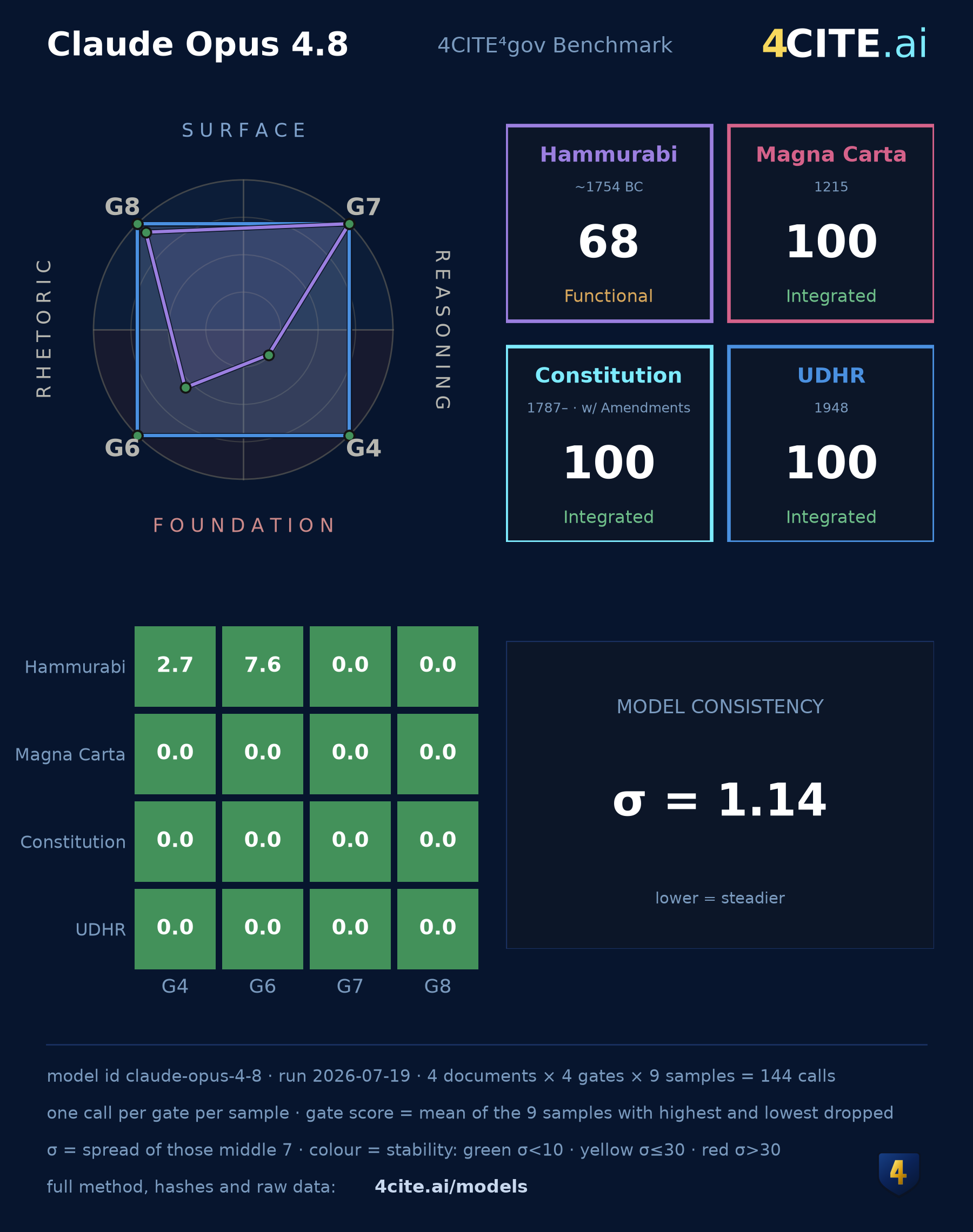
| Document | G4 | G6 | G7 | G8 | Composite | σc | Tier |
|---|---|---|---|---|---|---|---|
| Code of Hammurabi (~1754 BC) | 23.9 σ 12.4 | 54.9 σ 8.8 | 100.0 σ 0.0 | 92.0 σ 0.0 | 67.7 | 3.81 | Functional |
| Magna Carta (1215) | 100.0 σ 2.7 | 100.0 σ 1.3 | 100.0 σ 0.0 | 100.0 σ 0.0 | 100.0 | 0.74 | Integrated |
| U.S. Constitution (w/ Amendments) | 100.0 σ 0.0 | 100.0 σ 0.0 | 100.0 σ 0.0 | 100.0 σ 0.0 | 100.0 | 0.00 | Integrated |
| UDHR (1948) | 100.0 σ 0.0 | 100.0 σ 0.0 | 100.0 σ 0.0 | 100.0 σ 0.0 | 100.0 | 0.00 | Integrated |
Each gate score drops the highest and lowest of its 9 samples and averages the remaining 7; σ is the standard deviation over all 9 raw scores of that cell. Model consistency σ = 1.14 (mean of the four per-document composite σ values). Run cost: $13.51 in API spend.
What the run shows
Claude Opus 4.8 read the four documents with the steadiest hand the series has measured so far: model consistency σ = 1.14, with 14 of the 16 cells returning identical scores across all nine samples. The U.S. Constitution and the UDHR each came back 100.0 thirty-six times in a row. Magna Carta joined them at Integrated with a composite of 100; the Code of Hammurabi read 67.7, Functional.
All of the discrimination happened on the foundation gates. Hammurabi’s G4 Paradox Resolution read 23.9 (the code proclaims its own perfection and seals itself with curses, leaving no mechanism inside the text for surviving challenge) and G6 Latent Intent read 54.9, while its G7 Argumentative Structure (100) and G8 Rhetorical Architecture (92) scored as fully formed. A 3,700-year-old legal code is not incoherent; what it lacks, on this read, is the structural capacity to be argued with. That is the arc this corpus was assembled to expose: divine command reads Functional, while the frameworks that constrain power (Magna Carta, the Constitution, the UDHR) read Integrated.
Set against the Grok 4.3 run, the two model families agree on the shape and disagree on the details in an instructive way. Both put Hammurabi far below the other three, and both located the deficit first at G4: Grok read it 26.9, Opus 23.9, nearly the same number from independent architectures. They part ways above the waterline: Grok read Hammurabi’s rhetorical architecture at 20.0, Opus at 92.0. One model treats command-and-curse rhetoric as a structural failure, the other as competent architecture in service of a different end. Disagreement of that kind is exactly what a pre-registered public protocol is for: every sample behind it is published, per cell, either way.
One disclosure belongs on this page: Claude Opus 4.8 is the production scorer inside 4CITE’s own engine, selected in part for the determinism this run now makes publicly measurable. The gate prompts used here are the same production set the engine runs: versions recorded above, unmodified for this occasion. Read the σ column with that in mind.